
How Can a Foreign Language Teacher Improve Their Pronunciation?
Pronunciation plays an important role in communication, because it reflects our mood, our confidence, our ability to get information across, our education and our professionalism. Pronunciation has a huge influence on how people perceive our message and us as speakers, whatever the context: an international professional conference, talking to a foreigner in a new country or a personal conversation with a relative. The way we speak tells people far more about us than we might imagine.
And for a foreign language teacher, improving pronunciation is a must. After all, the teacher is the model of correctness for their students.
The more accurate your pronunciation, the more people trust you and see you as an expert. Excellent pronunciation will not only help others understand you better, but will also have a positive effect on your own perception of connected speech.
The good news is that anyone can improve their pronunciation, because it is a physical skill that needs regular practice.

What is pronunciation made of? Aspects of pronunciation
First, let’s look at the components that make up pronunciation. Pronunciation is not only about saying words correctly, as it might seem at first glance.
Sounds
This is the component people usually start with when working on their pronunciation. English has 44 sounds (phonemes). Like any other language, English has unique sounds that you need to master to sound more natural in conversation.
Stress
Without any doubt, stress plays a very important role in how speech is perceived. Wrong stress can spoil the impression of you as a professional. What is more, stress can completely change the meaning of a word (for example, PREsent is a gift, while preSENT means to introduce or show).
Intonation
Pronouncing individual words correctly is a good skill, but it will not help much in real conversations. Intonation is one of the aspects that can either make your speech lively and convincing or turn it into a real disaster.
Rhythm
Rhythm follows different patterns in every language. As a component of pronunciation, rhythm is the sense of movement in speech, shaped by stress, tempo and the number of syllables. In English, rhythm is based on the contrast between stressed and unstressed syllables.
How to get closer to native-like pronunciation
To become a professional in any field, you need to master both theory and practice, and pronunciation is no exception. Without basic knowledge of how something works, it is quite hard to use it effectively in practice, because theory and practice are closely linked and complement each other perfectly.
Knowledge of phonology
Although today we are witnessing technological progress in every area of our lives, there are still somewhat old-fashioned but extremely effective tools for working on pronunciation. One of them is the phonemic chart.
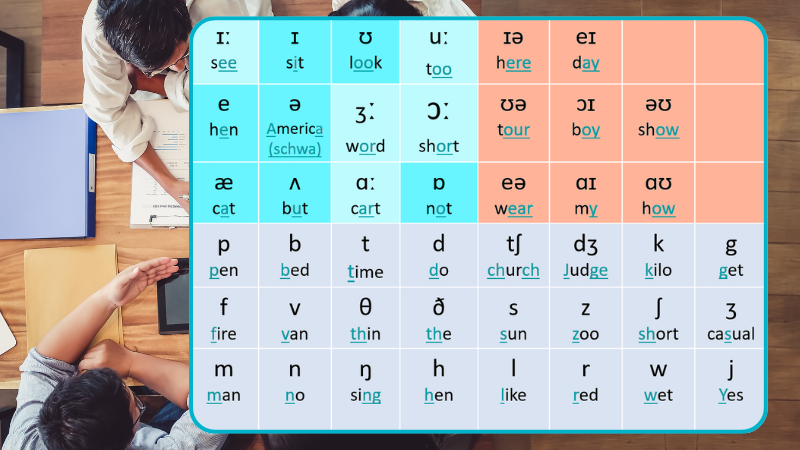
This chart is a visual representation of sounds. It contains the symbols used for phonemic transcription in dictionaries. Today many online dictionaries have audio. But once you know these symbols, you will no longer depend on dictionaries or on whether they have audio. To check how well you know the symbols, try writing the phonemic transcription of these words: referee, internship, question, subtle, circumstance.
Places and manners of articulation of consonants. Types of vowels
All sounds can be divided into two large categories: consonants and vowels.
Consonants are mostly classified by place and manner of articulation.
You cannot always understand how a particular sound is produced just by watching and imitating others. That is why knowing the places and manners of articulation is very useful, even though this information is not the easiest to take in.
The place of articulation is the point where the airflow meets an obstruction. The obstruction can be the hard palate, the soft palate, the lips, the teeth, the alveolar ridge, the glottis and so on. By place of articulation, all sounds are divided into bilabial, dental, labiodental, alveolar, palatal, velar and glottal sounds.
The manner of articulation is how the airflow produces a sound as it passes through the vocal tract. By manner of articulation, sounds are divided into plosives, fricatives, affricates, approximants and nasals.
Vowels, in turn, are usually described by the following characteristics:
- Length: long or short;
- Tongue position from front to back: front, central or back;
- Tongue height relative to the palate: low, mid or high;
- Lip shape: rounded or unrounded.
Understanding the main characteristics of sounds will help you improve your pronunciation significantly, because it makes the process more conscious.

Practice makes perfect
Whatever topic we study, it will not bring results without practice. So let’s look at some practical tips that will take your pronunciation to a whole new level and help you feel more confident when speaking English.
Shadowing and mirroring
Shadowing is an extremely effective practical technique that not only improves pronunciation but can also be fun enough to practice regularly.
The idea of shadowing is to read a text at the same time as the speaker, trying to imitate their sounds, intonation, stress and pauses as accurately as possible. Over time, this technique will bring remarkable changes to the flow of your own speech.
How to practice shadowing:
- Choose an audio text with the accent you need (British, American, Canadian and so on).
- Listen to it one sentence at a time, pausing the recording and repeating after the speaker.
- You can print or write down the text to mark intonation and pauses in it.
- Even better, first try to write the text down by ear, and then compare it with the original.
Here are some useful resources for practicing shadowing:
- YouTube: find a speaker and a topic you like, so that the process is as engaging as possible.
- Youglish: a resource that helps you find videos where native speakers say a particular word or phrase in context (just type in the word or phrase). Listening to the example sentences, you can practice shadowing.
- Playphrase.me: a website similar to Youglish that lets you hear words and phrases in real situations.
You can also try the mirroring technique. It is very similar to shadowing, but here not only speech matters, but also non-verbal elements such as facial expressions and gestures. Some sources treat the two techniques as the same, but mirroring focuses on fully reproducing the speaker’s manner of speaking.
Whispering
You may wonder how whispering can improve your pronunciation if in real life we want to speak clearly. The point is that when you whisper, your attention moves away from your voice and its volume to the place where the sound is produced. This helps you feel better how certain sounds should be pronounced.
Mouth and lip exercises, voice warm-ups, tongue twisters
To pronounce individual sounds or a whole text properly, it is important to make time for special exercises. Make them part of your daily routine. These exercises do not take much time, but they will definitely have a positive effect on the quality of your pronunciation.
Tongue twisters
Tongue twisters are a very popular way to improve pronunciation and articulation. Here are some of the hardest ones:
- Pad kid poured curd pulled cod.
- Brisk brave brigadiers brandished broad bright blades, blunderbusses, and bludgeons—balancing them badly.
- Send toast to ten tense stout saints’ ten tall tents.
Reading aloud and singing songs
Do you love reading books? Why not combine it with pronunciation practice?
Choose a book or an extract from a book and start practicing. It is important not just to read, but to analyze the text: mark pauses, word stress (if needed), sentence stress and intonation.
First read in a whisper, paying attention to how sounds are produced and to the marks you have made. Start word by word, phrase by phrase, and gradually move on to sentences and paragraphs. The goal of this practice is to pronounce words, phrases and sentences correctly.
Singing songs is a simple but effective and fun way both to learn English and to practice pronunciation. Focus on the singer’s way of pronouncing words and try to reproduce it. Also pay attention to contracted verb forms and colloquial phrases that are often used in informal speech. This is a great chance to practice saying them.

Apps and online resources for working on pronunciation
Thanks to modern technological advances and artificial intelligence, we can now improve our English with the help of technology. This makes learning and practice much easier and far less stressful.
Here is a list of useful apps and online services that will help you on your way to better pronunciation:
- ELSA AI
It is quite simple to use: type in a word, listen to the correct pronunciation, record how you say it, get instant feedback on how accurate your pronunciation is, and listen to how other people say the same word. You can use the shadowing technique for the best effect. You can also do daily training sessions that show which sounds you pronounce incorrectly and how close your pronunciation is to that of native speakers. A 7-day free trial is available. - Pronunciation — English Pronounce (for iOS)
This app is designed to improve American English pronunciation. Listen to and repeat individual sounds and words, and read detailed descriptions of how to produce a particular sound properly. The app also includes videos on pronunciation practice. It has a word search feature where you can see a word’s definition and transcription, listen to the correct pronunciation and, of course, record your own. - Say it (for iOS)
This app will help you practice British pronunciation. It lets you record your pronunciation, analyze it and improve it. The app suggests words according to the level you choose. It also includes interactive charts with vowels, consonants and diphthongs.
Conclusion
Whether we like it or not, people often judge others’ knowledge and professionalism by how they pronounce words and present their ideas. For English teachers, improving pronunciation is a real necessity in order to be a good example for their students. Improving your pronunciation is not an easy path, but it is definitely worth the effort. Be patient and persistent and, just as importantly, enjoy the process!