
Teaching English with Songs
One of the most common challenges teachers face when teaching English is keeping students interested throughout the lesson. That is why teachers are always looking for more creative ways to run lessons. One of these ways, which stands out for its effectiveness and student engagement, is teaching English with songs.
Songs have a unique ability to capture students’ attention and make learning more interesting and productive. In this article we look at the benefits of using songs in English lessons, the skills that can be improved with such lessons, and practical tips on preparing and using songs effectively in class.
Why are songs a good way to learn English?
Using music in language learning can be a powerful tool in a teacher’s toolkit. Here are some convincing reasons why using songs is a good way to learn English:
- Improving and practicing language skills. First of all, using songs in English is a really fun and engaging way for students to improve different language skills. So encourage students to take an active part in these activities, and prompt them to use the language they are learning in meaningful situations to help them absorb and use new knowledge.
- Increasing motivation. Using songs in class makes learning much more interesting for students. This increases their motivation to learn and encourages them to take part in classroom activities.
- Cultural immersion. Many songs reveal cultural aspects of English-speaking countries, including their history, traditions and social issues. By listening to and analyzing such songs, students gain a much deeper understanding of the culture and the language they are learning.
- Using a song as a starting point for discussion. The themes and content of songs can be a good starting point for discussing topics and ideas such as love, friendship and culture, as well as various social issues. Encourage students to share the thoughts and ideas the song’s story brings up for them.
- Variety in lessons. Using songs adds variety to lessons, because songs are usually not part of standard curricula. You can make the learning process more exciting for your students while helping them improve their language skills.
- An emotional connection. Songs evoke emotions and feelings, which in turn makes it easier for students to remember vocabulary and expressions, because these are now linked to certain emotional experiences.

Which skills can be practiced with songs?
Using songs in English teaching helps develop and practice the full range of language skills. Here are some of the skills songs can help improve:
- Listening. Songs are a great opportunity for students to practice listening, because to understand the lyrics and the meaning of a song correctly, they need to listen very carefully. Let students listen to the song several times, trying to catch specific details: vocabulary, grammar structures or pronunciation. After listening, you can ask them questions to check their understanding of the song’s meaning.
- Reading. Give students the lyrics so they can follow along while listening. This will help improve their reading comprehension and enrich their vocabulary.
- Speaking. You can organize discussions of certain situations and expressions from the song, or use them as a starting point for a debate.
- Writing. Ask students to write a few sentences about how they understood the song, or their thoughts on the themes and issues it raises. You can also give students writing topics related to the lyrics.
- Critical thinking. Use the song as a basis for critical thinking tasks. This can be analyzing the lyrics to understand their meaning, drawing conclusions about the song or evaluating its content.
- Vocabulary. Songs often contain lots of interesting vocabulary, idioms and expressions. Encourage students to pay attention to unfamiliar words in the lyrics and find their meanings. You can also create vocabulary exercises based on the song to help students learn and consolidate new words.
- Grammar. Choose songs that contain examples of exactly the grammar structures you want to study and practice with students. You can create tasks based on the lyrics to help students understand and use these grammar structures correctly.
- Pronunciation. Singing helps students improve their pronunciation and intonation. Encourage them to pay attention to the stress and rhythm of the lyrics and to sing along while they listen.

How to choose a song for a lesson
To teach English effectively with songs, it is important to choose them well and follow a certain structure. Here are the points to consider when choosing a song for a lesson:
- Choosing the right song: choose only a song that suits your students’ age, level and interests. The lyrics should be clear and understandable, and the vocabulary should match the students’ learning goals.
- A poll with Mentimeter: if you want to take your students’ preferences into account, create a poll and ask them to share the names of their favorite songs, singers or bands.
- The right length: make sure the tasks related to the song do not take too much time, and that the song lasts no more than 2-3 minutes.
A tip for teaching young learners: choose songs with lots of rhyming words and repeating rhythms. This will make it easier for children to learn new words and help them start singing along. You can use songs that help students practice target vocabulary (for example, colors, animals, actions, numbers, weather).
How to work effectively on listening
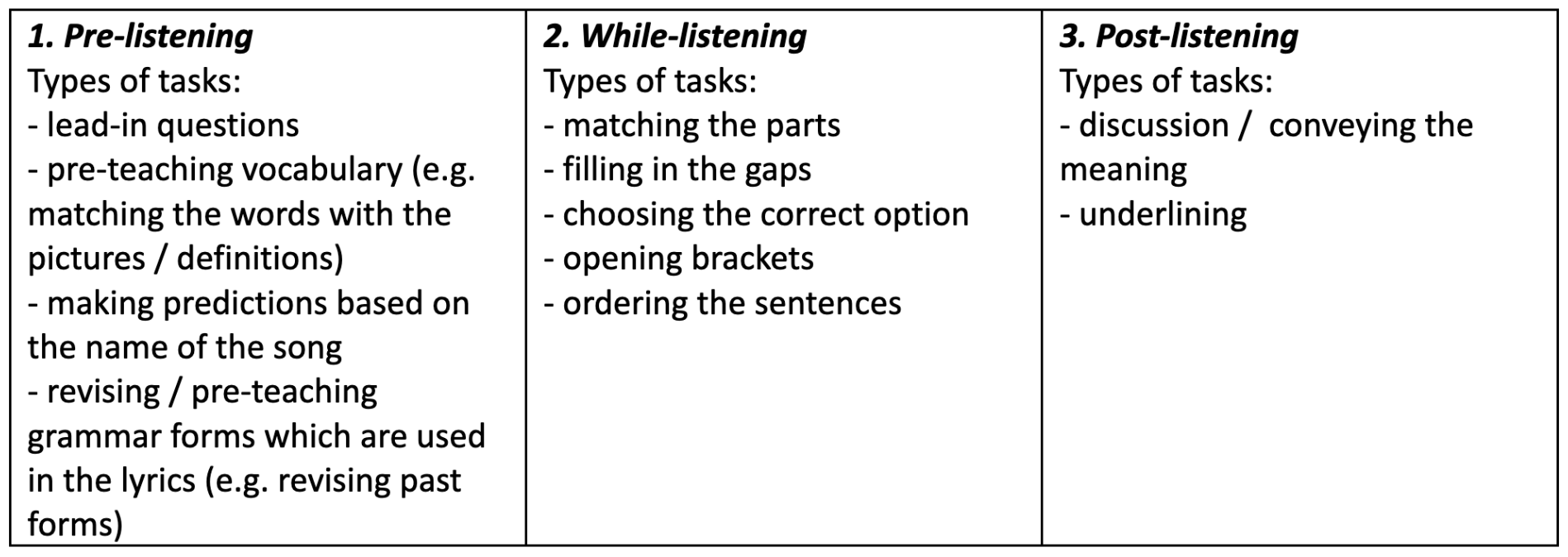
When presenting a song to students, follow the logical sequence of listening stages so that the process is structured and supports students’ understanding and engagement. Listening consists of three stages:
- Pre-listening. Before you play the song, share its topic and idea with students. Ask them to predict what they might hear in the song based on the topic. Give students handouts or worksheets with the lyrics.
- While-listening. Let students listen to the song from beginning to end without stopping. Use the song as a basis for various vocabulary exercises, grammar analysis or writing tasks.
- Post-listening. After students have listened to the song, encourage them to discuss its theme, meaning and the emotional reactions it brought up for them.
Conclusion
Teaching English with songs is a dynamic and engaging approach that can bring students a great deal of benefit. Songs not only increase students’ motivation and cultural awareness but also expand their vocabulary, improve pronunciation and develop language skills. When preparing songs for lessons, make sure they suit the students’ age, the curriculum and the context. Follow the right sequence of listening stages to help students understand the lyrics as fully as possible.
Use worksheets with lyrics and tasks to consolidate the material. With the right approach, songs can become a valuable tool for an English teacher, making the learning process even more interesting and effective for your students.