
Gamification: Using Game Elements in Learning
In short: Gamification means adding game elements (points, leaderboards, levels, rewards) to learning to increase students’ motivation and engagement. It combines well with the flipped classroom and works both online and offline.
Gamification means adding game-like elements to non-game activities, turning learning English, even English for specific purposes, into an exciting and enjoyable experience. However, the main focus of gamification is not just entertainment: it is an approach to motivating students by increasing their interest, creating interactive learning materials and supporting learner autonomy.
Gamification began to be widely adopted in the second half of the 2010s. Unlike earlier studies that assumed online gamification focused mainly on vocabulary learning, the approach is now widely used in teaching vocabulary, grammar, listening, speaking, reading, writing, pronunciation, college English and even English literature. This shows how practical gamification is in real EFL/ESL classrooms.
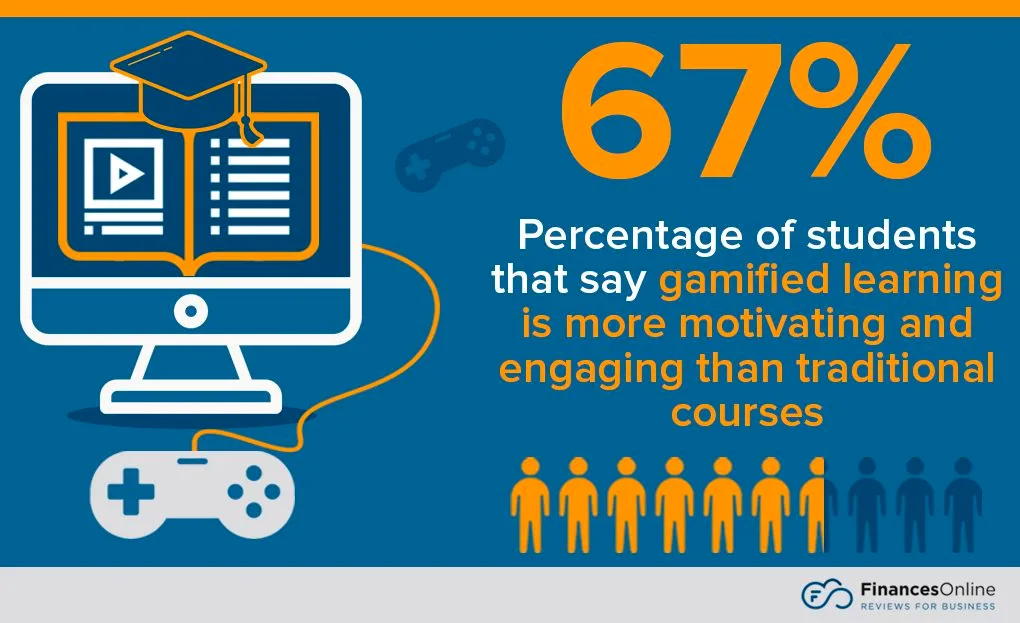
“54 Gamification Statistics You Must Know.” Finances Online. URL.

“Gamification In Education For Sustainable Development. European Proceedings.” URL.
Gamification and the flipped classroom
Besides using games and game elements in traditional teaching, let’s remember the flipped classroom method and how much new and interesting this teaching concept can bring into students’ lives. Independent study often takes place on interactive platforms with points and progress tracking, which resembles a gamified environment.
When we say “gamification”, we very often mean both gamified learning and game-based learning. But although they are similar, the two approaches are different. So what is the difference?
The biggest difference between game-based learning and gamification lies in applying them in non-game contexts. For example, gamification in your classroom could be a leaderboard for students who completed their homework on time every day, with a reward each month for the longest streak.
Gamification means bringing aspects of game design into the learning process. This includes features such as:
- earning badges
- using point systems
- getting onto leaderboards (for example, on the well-known ClassDojo)
- collecting other rewards (for example, “prizes” you invent)
- using “competition” and contests (with a timer, for example)
- using gamified classroom management tools (for example, “noise detectors”)
Although game-based learning and gamified learning are different (and we should remember this as English teaching professionals), both methods certainly help engage students and improve the learning process. So let’s use both! Check out the table and example below ⤵️⤵️
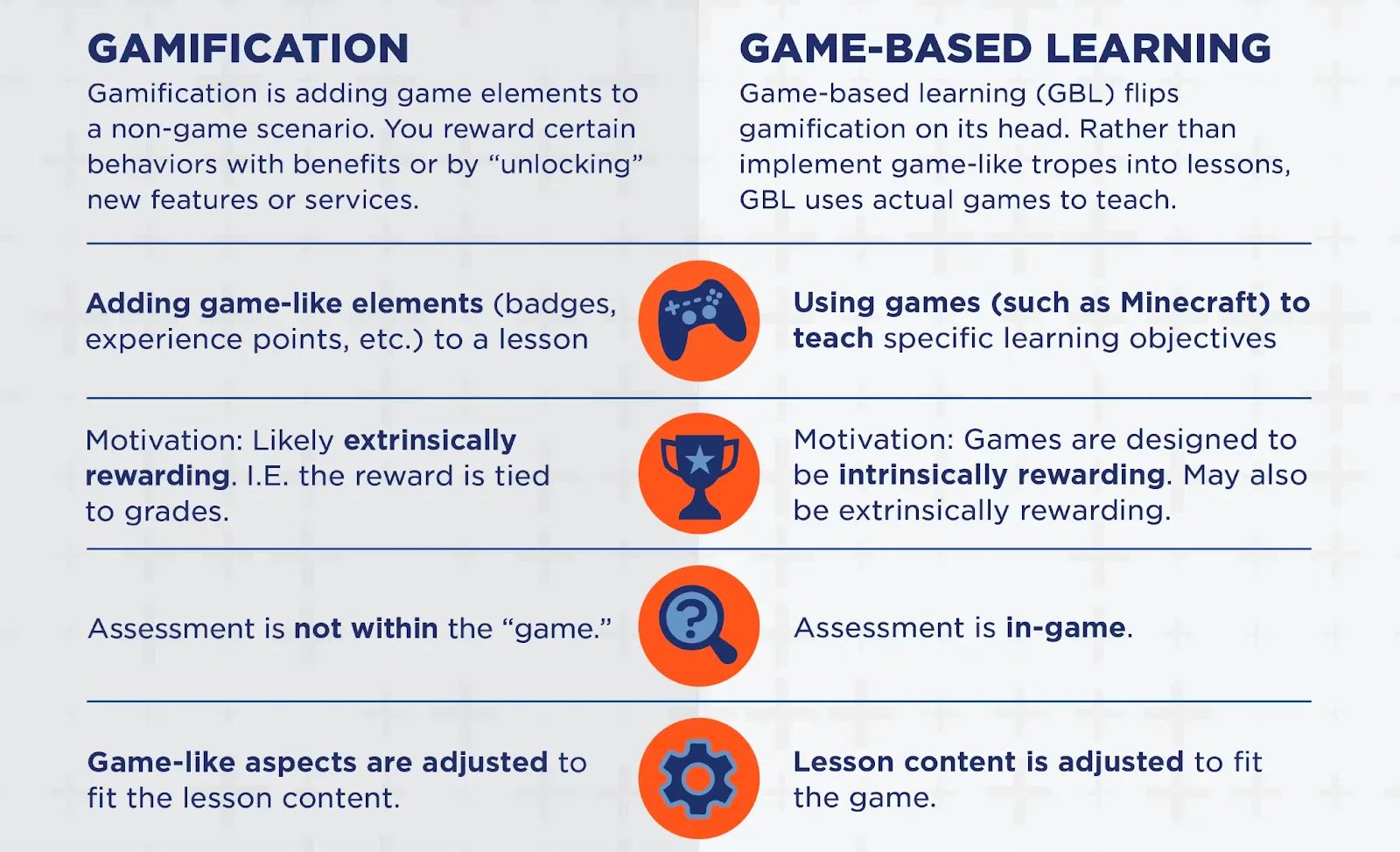
“Game-based learning vs. Gamification.” Prodigy.
GBL: examples of games
In our English lessons we have a whole set of interesting games that we like to use both online and offline. Each has its own rules and rewards for the winners: for example, interactive vocabulary challenges, language puzzles and team competitions. Look at the examples below, and maybe you will use them for some purpose in your very next lesson:
Online quizzes
Websites
- Wordwall (puzzles, crosswords, guessing games, quizzes, memory games)
- Genially (board games, tic-tac-toe, battleship, quizzes, hangman)
- LearningApps (puzzles, crosswords, guessing games, memory games, ordering tasks)
Offline games (besides countless board and card games :) )
- Broken telephone: players line up and whisper a message from one to the next until it reaches the end of the line. The last person in the line repeats the message. The message can be whispered only once, without trying to change it.
- Charades: one student from a team (the actor) stands in front of the class. The actor tries to make the rest of the team understand what is on the screen or paper that only they can see, using only gestures, without sounds (or by drawing letters in the air!). The team has thirty seconds (or one minute) to guess as many words or sentences as possible. Try it online too.
- Alias: teams take turns, and on each turn one team member explains the words on word cards to the others. The other team members guess the word, and each correctly guessed word earns the team one point.
- Pictionary: one student is chosen to be the first to draw a picture from the stack of game cards. Once they see the word, they have five seconds to think before they start drawing. After they start drawing, they have one minute for their partners to guess the word. Try it online too.
- Running dictation (races): in pairs, one student is the “reader” and the other the “writer”. Readers run to a part of the text, read one or two sentences, memorize them, return and dictate them to their writer, who listens and writes down what the reader says. Then let students swap roles.
Gamification: the elements of gamification
The most frequently used elements of gamification are feedback, points, quizzes, digital badges, leaderboards and rewards (usually given to students for correct answers), followed by progress bars, stories, challenges, videos, time limits and competitions. Less frequently used elements are avatars, collaboration, role-play, QR codes and so on.
All of them, including badges, rewards, cumulative points and competition points, provide visible incentives for students and the expected behavior in education.
Most games share several common features. The examples below are worth including in one of the activities you do in class:
- Goals: a mission or aim the player must achieve or solve. (How about announcing the list of tasks for today, the agenda and the goal you need to reach by the end of the lesson? For example, “Read the text, complete two grammar exercises and find someone who… by 6:50 pm”. Announcing lesson goals to your students will keep them motivated to reach them, keeping them active and interested.)
- Badges for achievements: every time a player reaches a certain milestone, they get a medal or badge and the motivation to achieve more. (Do not forget to use a visual motivation system on the board, whether in an online or offline class (❤️ / ➕). Give students extra points or marks for every small achievement during the lesson, such as completing individual tasks or stages of the lesson, keeping the “game” element.)
- Progress indicators and leaderboards: they show the player’s position and how far they are from the goal.
- Rules: instructions and limits for players during the game, which push them to be creative and develop strategies to win (try applying these elements following your teacher’s instructions, especially with young learners).
- Levels: each task or activity gets harder as players unlock goals or move on to the next level.
- Rewards, points and second chances: by collecting medals, points or objects, some games give a new tool, a superpower, immunity or even an extra life that can be used later. (Consider rewards beyond small tokens, such as including games or singing at the end of the lesson as incentives. You can also introduce the idea of “extra lives” for students who occasionally break the English-only rule.)
- Choice: students make decisions and face different challenges depending on their choices.
- Competition, collaboration and challenges: play against others or work as a team to reach a common goal.
- Time: add extra pressure to a game or any activity or task you do in class by setting a time limit for completing a level or task.
- Story, plot, characters and role-play: include a storyline with characters and different places where events take place. (Of course, for young learners! Creating a story that prompts students to complete tasks as part of a quest or to rescue someone can make lessons more exciting and meaningful for them. This storytelling approach adds an element of adventure and purpose, capturing young learners’ attention and imagination while increasing their motivation to take part in various learning tasks.)
When and how to use gamification and GBL
Game activities or elements of gamification can be successfully included at the start of lessons (warm-up), in language practice, skills work, review or extra homework. If lessons do not have elements of gamification, consider adapting them using the examples above or applying the suggested gamification elements. However, keep the following in mind:
- Balance game elements with standard practice to avoid unnecessary distractions
- Remember that not all students like every game, and try to ensure inclusion
- Avoid excessive competition, as it can reduce the motivation of those who lose to take part in future games.
Look at the examples below and decide whether the activity is part of game-based learning (GBL) or simply contains elements of gamification.
- Lead-in activity. A lead-in activity is an important task designed to capture students’ interest and engage them from the very beginning (this is even emphasized in Jeremy Harmer’s ESA approach). Using gamification or GBL in lead-in activities can help achieve this goal even better.
- Introducing new language. When it comes to introducing new language, the prevailing approach in modern language schools is checking understanding rather than direct presentation. However, there are situations when it becomes necessary to introduce certain language for learning. Flashcards help achieve this goal thanks to their visual appeal and ability to attract attention. Still, even flashcards can be presented in a more interesting way to enrich the learning process.
- Main activity. Students are not very fond of grammar exercises, especially when the topic is difficult and involves many tasks. In these cases it is important to add games or elements of fun learning. This helps balance the difficulty and keeps students motivated.
- Extra homework. Of course, although independent study is useful, you may consider extra homework for difficult topics. To make it more interesting and less burdensome, gamifying these extra vocabulary or grammar practice tasks is a great idea. The extra task then becomes a chance for more “play” rather than just an additional load.
Advantages and disadvantages of gamification
Research findings on the impact of gamification on learning English as a foreign or second language are mixed. A large number of studies report and confirm the potential benefits of gamification for students learning English, including:
- reducing students’ anxiety about learning English;
- increasing students’ interest, motivation and engagement in learning;
- improving students’ learning outcomes;
- supporting learner autonomy.
However, some other studies concluded that students who had access to gamified content performed better in the short term, but this did not affect their final learning outcomes.
Gamification is a double-edged tool. For students who are bored and unwilling to learn, rewards and incentives can increase their motivation, while for students who are already motivated, gamified learning activities can harm their intrinsic motivation.
The benefits of gamification in learning English as a foreign or second language can be analyzed from three angles: improving students’ language skills, a positive effect on their attitudes and emotional responses, and creating an authentic language environment that develops students’ overall competence.

First, a gamified learning environment has been found to help EFL/ESL students improve their listening, speaking, reading and writing skills compared with traditional learning environments. Schools and teachers need to give students dynamic learning materials and pass on knowledge effectively. Gamification is a useful approach for providing dynamic materials. It can be used not only for learning and teaching but also for review and assessment. As a result, it can improve students’ English competence and help them build the habit of self-study.
Second, gamification can have a positive effect on EFL/ESL students’ attitudes and emotional responses in terms of interest, motivation, anxiety and a sense of achievement. Increased motivation to learn is one of the most frequently mentioned positive outcomes in the reviewed articles. Students found the gamified approach innovative, interesting and game-like, helpful for learning English and supportive of their interest and engagement in learning English, as well as their inclusion and enthusiasm. All these strategies are used to increase students’ motivation, which leads to engagement and is the main driver of successful EFL/ESL learning.
Third, gamification helped create an authentic language environment for learning and developed students’ comprehensive literacy. Gamification provided an authentic language environment through digital gamified situational storylines, improved students’ communication skills, and there were strong recommendations to include play in learning and integrate it into school curricula. Gamification can also provide a more enjoyable learning environment and opportunities for collaboration, creating an interactive atmosphere, increasing student engagement and developing their communication skills.
In addition, students can improve their 21st-century skills, including computer literacy, critical thinking, digital literacy and problem-solving. Learner autonomy also grows, as students can correct their own mistakes with minimal stress. They progress by learning at their own pace.
However, gamification is not a perfect approach.
The disadvantages of gamification include technical problems, fixed learning procedures and the potentially pointless use of game elements in teaching, which does not necessarily improve students’ English skills and can cause high levels of anxiety about learning in class. Gamification creates a quantitative assessment of the learning process by measuring students’ performance in numbers (time, points, levels and so on). In addition, some gamified elements, such as leaderboards and a competitive context, may discourage some children rather than strengthen their academic performance.
FAQ
How does gamification differ from game-based learning (GBL)?
Gamification adds game elements to ordinary tasks, while GBL (game-based learning) means learning directly through games.
Which game elements can I use in English lessons?
Points, levels, leaderboards, badges, rewards, competitions and challenges, plus online quizzes and websites with game-based tasks.
Does gamification have downsides?
Yes. Research results are mixed: some studies show only a short-term effect, and for students who are already motivated, game rewards can harm their intrinsic motivation.