
Incoming Leads: Where a Business Loses Money Before Classes Even Start
In short: Money gets lost between advertising and payment when marketing and sales work separately, leads are not qualified, replies are slow and CRM funnel stages have no clear criteria. The article’s seven steps show how to build a lead’s path from first contact to payment and repeat sale.
A business that does not earn money goes against its own nature. It is born to create value and serve a mission, and profit comes as a consequence: a sign that you have found a product someone needs, found people willing to pay for it, and built your operations so that everything actually works. Money in a business is about its health, its ability to grow and the motivation of the team.
In this article we break down, step by step, how to work with leads so that money does not get lost between advertising and payment.
Step 1. Two funnels: where marketing ends and sales begin
The marketing funnel is responsible for acquisition: it makes a person notice you, take a closer look at the product and want to get in touch. It ends at the moment of first contact, when the contact details have been left. Marketing reports the number of leads, meets its KPI and passes the baton. For sales, this is exactly where everything begins.
The sales funnel turns an interested person into a client. Marketing and sales often seem to live in different worlds: each has its own metrics and works for itself. But the system only works when both pull toward the same result.
They need a shared goal, conversion: how many of the people brought in by marketing reached a trial lesson, became clients or started studying. And sales should tell marketing where the best leads come from, so that every next wave of leads gets better.
For marketing, a lead is just a phone number, a name and a few form fields. For sales, it is a request, and it does not only come from advertising: it can come from a referral or from a regular client who came back on their own. That is why the first point of analytics is very simple: who contacted you, known or unknown, new or returning.
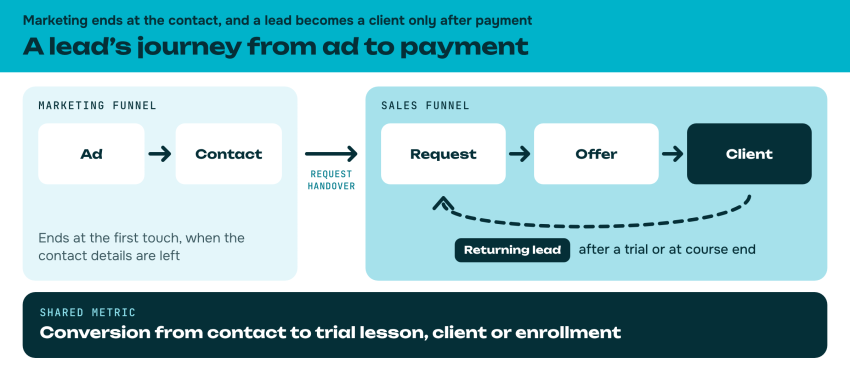
The diagram shows a lead's journey from advertising to payment: where marketing ends, where sales begin and where the client returns after a trial lesson or at the end of a course.
Step 2. Lead or client: when a contact really becomes a client
Every school decides for itself up to what point a person counts as a lead. Some count them as a client after sending an offer, others after agreeing on a trial lesson, others after the trial itself. But in sales, a lead stops being a lead only when they are ready to pay: “Send me the invoice, I’ll pay”.
Until that moment, the request should be qualified and segmented, and as much information as possible should go into the CRM. Otherwise you will not be able to understand anything later: why leads get lost, which scenarios work worse than others, how many people came with a particular motivation or level of knowledge. If the database holds only a phone number, there is nothing to analyze.
Returning leads. Even after paying, a person can become a lead again:
- The first lesson is paid, so the client has already given you money. But after the lesson they go back into the pipeline as a returning lead, together with the results of the trial lesson.
- The client paid for a four-month course. When the course is coming to an end, they are taken through the path again: reminded of the value and offered the next stage. It is better to create such leads in the CRM automatically and in advance, so that the manager does not have to search for whom to offer what.
- The renewal is obvious and there are no questions. In that case there is no need to turn the person back into a lead.
First write down the process, and only then automate it. While a scenario lives in your head, it seems simple. But as soon as you start describing it, lots of nuances come up.
Step 3. Qualification and scenarios: do not handle everyone the same way
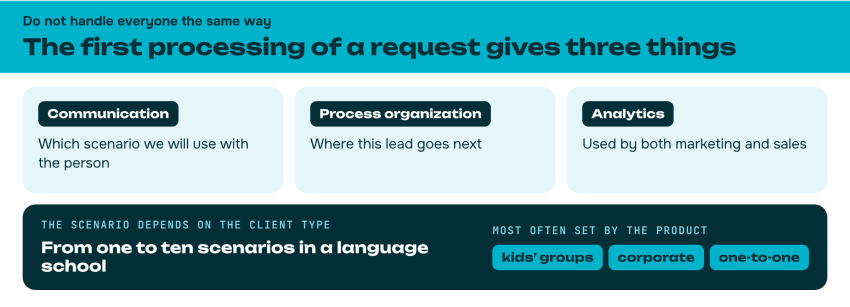
The first processing of a request gives you three things: communication (which scenario we will use with this person), process organization (where this lead will go) and analytics (used by both marketing and sales).
The manager needs to know which ad the request came from and what exactly caught the person’s attention. Qualifying questions should be precise and help the manager, not just find out whether you have studied English before. They should suggest how to approach the person.
The scenario depends on the type of client. The same woman can contact you as a mother choosing classes for her child and as an employee looking for a course for her company. These are two different stories: a different strategy, a different conversation, a different offer. On the corporate side she may already be your client, while on the kids’ side she is still a lead.
A language school can have anywhere from one to ten scenarios, and most often they are set by the product: group classes for kids, corporate training or one-to-one lessons.
The acquisition channel matters too, but mostly at the entry point. Picture a river fed by smaller streams: you qualify the person at the mouth and send them into the main current, without forgetting the details.
Some people prefer to write in a messenger and get materials in the chat, while others want to hear a live voice. Automation, such as a chatbot that replies to the word “course” with a presentation, saves the manager’s time but changes their task: they respond a little later and check whether the person understood the offer correctly.
Sales should pass this information back to marketing. With a full analysis of channels you can see which platforms bring better leads and save money on placements and advertising.
Step 4. Response speed: how long you can wait to reply
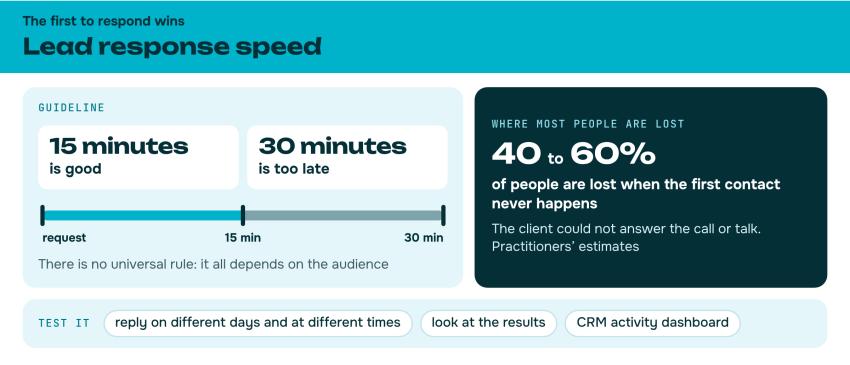
When we look for classes, we send out dozens of requests, and whoever responds first wins. A person needs to feel that they are not shouting into the void. As a guideline, 15 minutes is good, while 30 minutes is already too late. But there is no universal rule, because everything depends on the audience:
- If someone has been asked to find a course for their colleagues, they act quickly, and whoever answers first wins.
- If someone is looking for classes for themselves and sends requests in the evening on the way home, a reply the next day is perfectly fine too.
A single standard for everyone would make everyone the same, and competition would come down to price and speed. The winner is the one who studies their own processes. Test it: reply on different days and at different times and look at the results. CRM systems have an activity dashboard by day and hour that shows when your audience is most active.
Most often people are lost not because of a 20- or 30-minute wait, but because the first contact never happened at all: the client could not answer the call or talk. According to practitioners, this is how 40 to 60% of people are lost. Many more drop out after the second touch with the words “I’ll think about it”.
That is why every stage needs its own goal and a measurable result. “All new leads have been called” is not yet a metric: a conversation has to take place, and the basic data has to be collected.
Step 5. Funnel stages in a CRM: when a stage is really complete
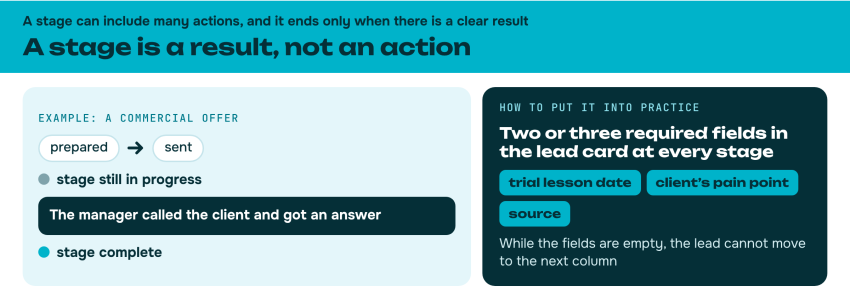
A stage is not an action, it is a result. A first call or a sent offer are not stages in themselves. A stage can include many actions, and it ends only when there is a clear result.
Take a commercial offer: you prepared it and sent it, but the stage is still in progress. It ends when the manager calls the client and gets an answer. This matters, because when asked “Have you had a look?”, people often say “yes”, even though they have already received a dozen similar offers and remember almost nothing.
The same goes for collecting information: you can call ten times, and the information-gathering stage lasts all that time until everything you need is in place.
How to put this into practice. In the lead card in your CRM, choose two or three fields that must be filled in at each stage: for example, the date of the trial lesson, the client’s pain point, and the source they came from. While the fields are empty, the lead cannot be moved to the next column.
This way leads do not get stuck, and you do not end up with a hundred of them in one column and two in another. The number of fields differs from business to business.
Step 6. A real case: lots of leads, few sales
For this breakdown we took one of the schools on the Voopty platform. We are not naming it, but many will recognize themselves. Courses last several months, the average order value is roughly 100-200 dollars, and sales go through managers.
What was wrong. The CRM held just a set of contacts, and it was impossible to work out who was who and where to direct efforts. Leads and clients were not separated by course, managers called chaotically, and requests got stuck in an unclear state: nobody knew why a person never made it to a trial lesson. The owner complained that advertising was not working, leads were cold and managers were not closing deals.
What was done:
- Leads and clients were separated: a contact is not yet a lead.
- Leads were split by client type and communication scenario, so irrelevant ones could be filtered out right away.
- A separate funnel was created for new leads and another for repeat sales, so that after a course new leads came from the existing base and not only from advertising.
- Rules were written for working with each funnel: the goal, the message and the actions.
- Responsibility was divided by stage: who qualifies, who prepares the presentation or offer, who runs the trial lesson and what they hand over next. Previously one person carried everything.
- Required fields were added to the CRM so that managers would not forget to ask important questions.
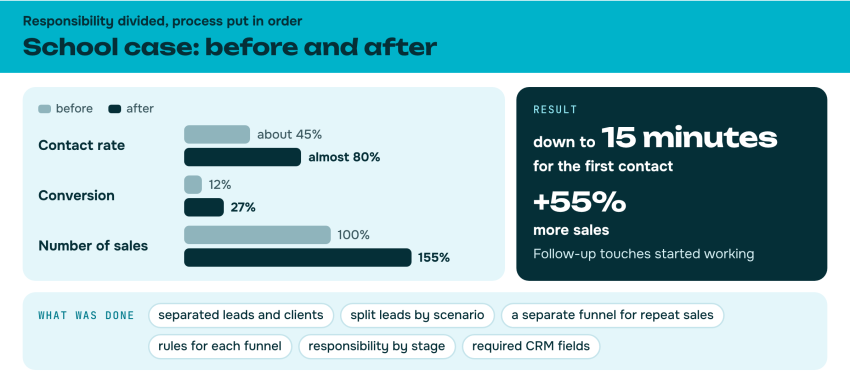
The result. First contact was cut to 15 minutes, follow-up touches started working, and sales grew by 55%:
| Metric | Before | After |
|---|---|---|
| Contact rate (calls answered) | about 45% | almost 80% |
| Conversion | 12% | 27% |
| Number of sales | 100% | 155% |
And all of this came simply from dividing responsibility and putting the process in order.
Imagine a person walks in through one door, but depending on who they are, you lead them into different rooms. Everyone on the team knows whom they are escorting to which room and who brings the guest tea, coffee or a flower.
Or remember a school relay race: the baton is most often dropped exactly when it is passed from hand to hand. It is the same in a funnel: most losses happen at the handover between stages.
Step 7. After the commercial offer: price, discounts and feedback
When a client receives a commercial offer, they usually have other things to do: they open it, see the number and leave. So during the call, first bring the person back to their own request. Remind them what mattered to them: the class schedule, the group size, the requirements for the teacher, and then show that the offer takes this into account. If a document starts with what matters to the reader, they will read it to the end.
The quality of feedback depends on the initial conversation: which questions you asked and how well you know how to ask them. When the offer matches expectations, price is no longer the deciding factor. A common mistake schools make is that the person expects a result, but they are told about the learning process, the platform and the lessons. The request was about one thing, the answer about another.
It is worth naming the price right away when you present the product. Discounts depend on the client and the market: in some places they work, in others they only irritate, and then it is better to replace them with nice extras. This is a big topic of its own that deserves a separate conversation.
Money does not disappear without a trace
After a breakdown like this, it may seem that a business has too many holes. But this is exactly how growth is built: first you see where the money was leaking, and then you close those gaps one by one.
Start small. Open your last ten leads and see where they are now. For many owners, this look becomes the moment when the money is finally “found”.
You do not have to build a perfect system in one evening. It is enough to close one gap each week, and in a few months the business will become calmer, more predictable and more profitable.
Money does not disappear without a trace. It stays where there is no system, and that is exactly where you can get it back.
FAQ
When does a lead become a client?
In sales, a lead stops being a lead only when the person is ready to pay: “Send me the invoice, I’ll pay”. Until then, the request should be qualified and as much information as possible recorded in the CRM.
How quickly should you reply to a lead?
As a guideline, 15 minutes is good and 30 minutes is already too late. But there is no universal rule: it depends on the audience, so test replying on different days and at different times and look at the results.
Why qualify leads?
The first processing of a request sets the communication scenario, decides where the lead goes in the process and gives analytics to both marketing and sales. The same person can come with different requests, and each needs its own strategy.