
Online School Growth Plan: From Chaos to Stable Profit
You run an online school. You have students, payments come in, teachers are teaching. And then the familiar part begins: ads get more expensive, margins shrink, and you have no weekends because you are still the one rescheduling lessons and reminding people to pay. It feels as if all you need is the “right” ad specialist or a rewritten sales script, and things will finally move.
Usually they don’t. The cause is rarely in the ads or the scripts. It sits deeper: in the business model, in how you work with a client after the first payment, and in the numbers the owner doesn’t see.
This was the subject of a webinar by Voopty and Turbo, where two practitioners shared their experience.
- Illia Litun, entrepreneur and founder of Turbo Education, an educational ecosystem and one of the leaders in preparing students for the NMT, Ukraine’s national university entrance test. More than 23,500 students have studied in his programs, and the project is on the Forbes Next 250 list.
- Natalia Lototska-Hevko, co-founder and CEO of Green Country, TalkEn.Cloud and Voopty. More than 18 years of experience in EdTech and in systematic school management, and a public speaker at leading education events.
You can watch the full webinar recording here (in Ukrainian).
This article sums up the key points of their conversation: what to keep in mind when you want to scale an online school. First we look at what the market looks like in 2026, then we go through seven steps: numbers and the business model, teacher payroll, niche and format, channels and funnels, LTV, automation and team, and the move to group classes. The market benchmarks come from open research, and we link to the sources. All of them describe the Ukrainian market, so prices are given in Ukrainian hryvnias (UAH).
The Ukrainian market in 2026: benchmarks for your numbers
Your own metrics say little until you have something to compare them with. Here are six benchmarks from open sources.
- Demand is high. 355,371 people registered for the 2026 NMT, 43 thousand more than last year, and English became the most popular elective subject: 112,064 applicants chose it (data from the Ukrainian Center for Educational Quality Assessment). According to a 2024 study by the Kyiv International Institute of Sociology (KIIS), half of students in grades 10-11 work with tutors (OBOZ.UA). And in the EF EPI 2025 ranking Ukraine is 45th out of 116 countries, so there is still plenty to learn.
- Online has become the norm. On the BUKI tutoring platform, from January to July 2026, 85.2% of requests allowed online lessons, 78.2% were for online only, and just 17.7% insisted on offline. More than half of all requests, 54%, were for languages (a special project by Inweb and BUKI).
- Prices are rising, but unevenly. An hour with a tutor cost UAH 374 on average in early 2026, 16% more than a year earlier. English is cheaper than average: UAH 356 per hour, up 9% over the year. In Kyiv the price of English lessons even fell by 3.8% because the market is oversupplied, while in Dnipro and Zaporizhzhia it rose by more than 40% (Osvita.ua, based on BUKI analytics).
- Teachers are getting more expensive faster than lessons. The median salary in job postings for English teachers in October 2026 is UAH 27,500, up 17% over the year. In Kyiv it is UAH 32,500, and for remote positions UAH 28,000 (Work.ua).
- A lead from ads costs hundreds of hryvnias. For online education and courses, agencies cite a benchmark of UAH 250-600 per lead from Meta (Rabbit Marketing). This is an estimate from practice, not statistics, but it shows the order of magnitude.
- Payback takes years, not months. According to Englishdom CEO Inna Lukaichuk, the average ROI of EdTech projects is 12-28% a year, and they pay back in 12-24 months (Inweb Media).
Put these numbers together and you will see the main tension in the market. An English lesson gets about 9% more expensive a year, teachers’ salary expectations grow by 17%, and advertising is not getting any cheaper. With this arithmetic, the one who earns is the one who counts.
1. Numbers and the business model
The days when “everything just took off” are over. A few years ago you could launch ads for a free lesson and watch the schedule fill up. Today the market is overheated: Green Country’s internal list has more than 2,000 English schools competing for the same spots in Google Ads. Marketing has become more expensive, and mistakes cost more.
So every hryvnia has to be allocated by channel and tracked, and decisions have to be based on data, not on feelings. “This channel seems to work” is no longer an argument. An argument is a spreadsheet that shows how much a lead cost, how many people made it to payment and how much money they brought in.
What a business model is
A business model is the configuration of components that lets you earn consistently: the teaching format, acquisition channels, the share of revenue that goes to teacher pay, and other resources. If there is a problem here, building everything else will be much harder. No sales team can rescue a model in which the school earns pennies on every lesson.
Three teaching formats
Start with the format, because it sets the ceiling for your margin.
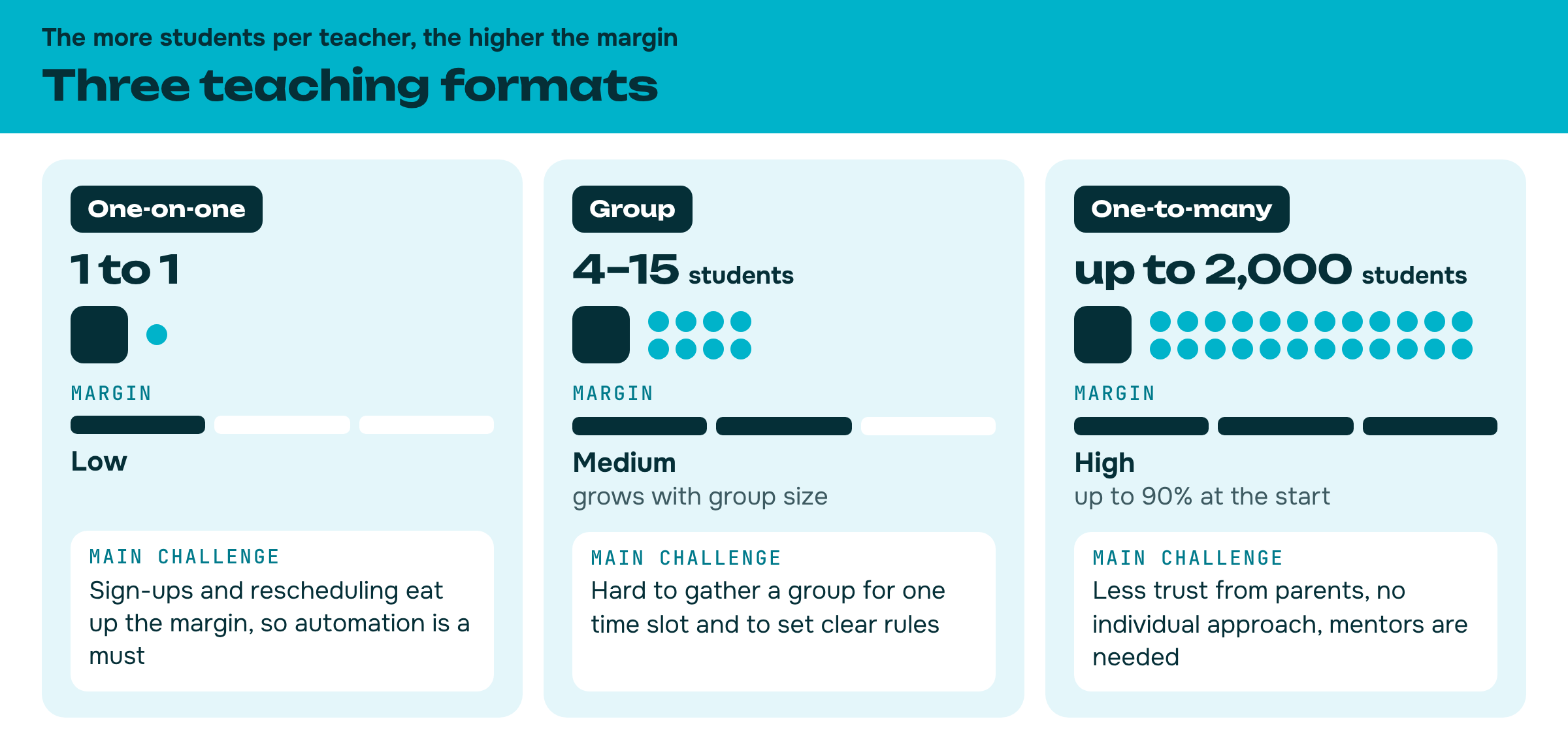
- One-on-one lessons are the easiest to organize but low-margin: one teacher, one student, one payment. Every rescheduled lesson and every payment reminder takes someone’s time, so without automation, operations will eat the entire margin.
- Group classes have a higher margin because several students pay for the same teacher hour. But they are hard to launch: you need to bring people together at one time and set clear rules.
- One-to-many is the webinar format: Turbo Education has about 5,000 active students, and a single webinar brings together up to 2,000 people. The margin is high (up to 90% at the start, lower as the team grows), but parents trust the format less and there is no individual approach. Mentors make up for this: they message students and make sure they don’t drop out of the process.
Different models can coexist in one business; the main thing is not to lose focus. If you launch one-on-one lessons, groups and webinars all at once, each one gets a third of your attention and none of them reaches its full potential.
What stage you are at
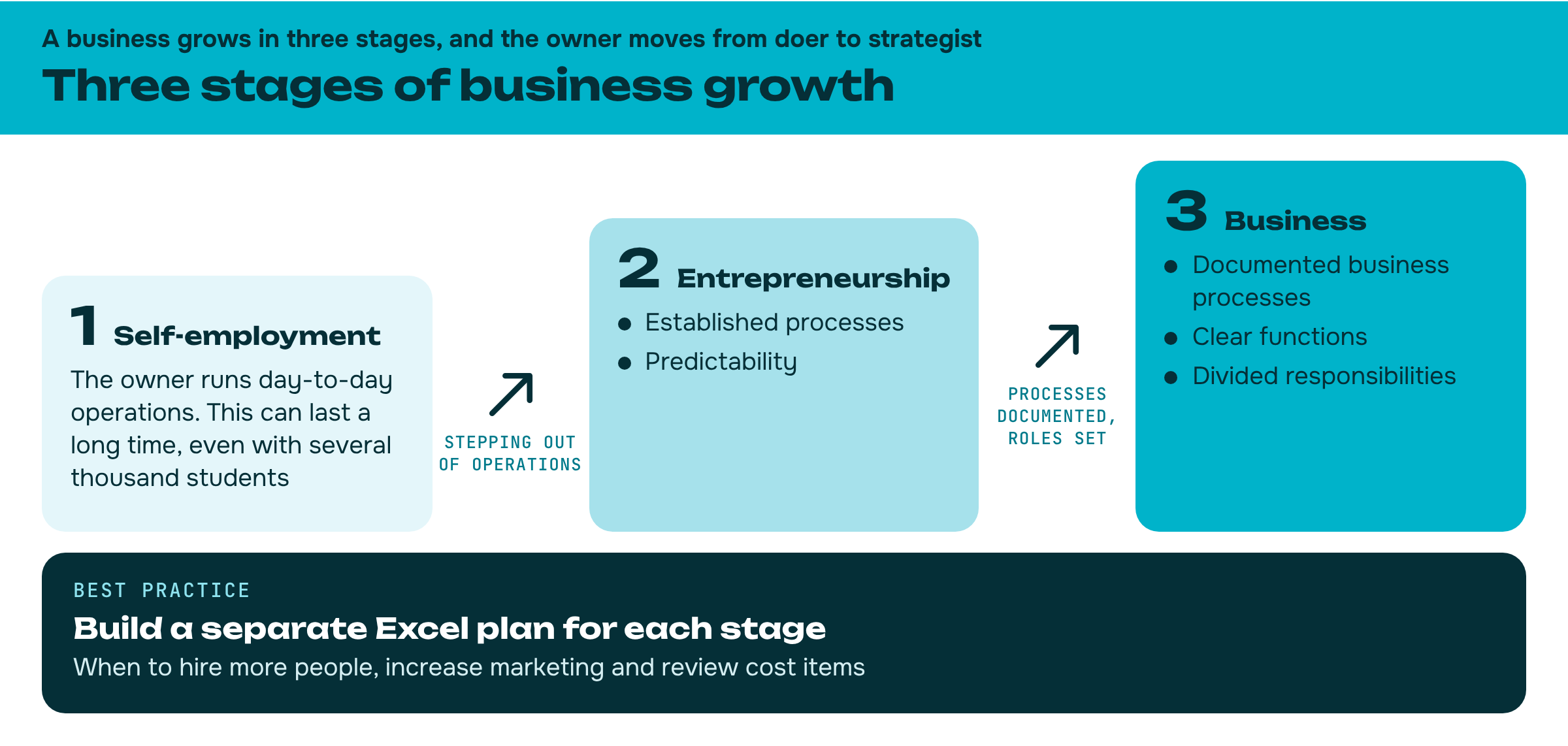
To understand where you are now, look at three stages of growth: self-employment (the owner runs day-to-day operations), entrepreneurship (established processes and predictability) and business (documented processes and divided responsibilities). At the first stage the school is you: if you get sick or go on vacation, everything stops. And this stage can last a long time, even when you already have several thousand students.
The best practice is to build a separate plan in Excel for each stage, so you know when to hire more people, increase marketing and review costs. Then you make the decision “it’s time to hire an administrator” not on the night when you can no longer keep up with answering parents, but at the moment the school reaches a mark you set for yourself in advance.
2. Teacher payroll
Teacher pay is what most often breaks the business model, and the scenario is almost always the same. The owner taught alone for a long time, then brought in colleagues and gave them 70-80% of each payment. It seemed fair: they do most of the work. While the school is small, what is left is even enough for a small profit.
When the owner decides to hire a sales team and increase marketing, a crisis hits: giving away 80% is no longer possible, and changing the arrangements is not easy. It is hard to explain to people who are used to one rate why tomorrow it should be half as much.
What benchmark to use
The benchmark at the start: 35-40% at most of the lesson fee, and more reliably fixed market rates, as at Green Country. With long-standing teachers it is better to honor the existing arrangements and apply the new terms to new people.
The market rate is easy to check. According to Work.ua, the median salary in job postings for English teachers in October 2026 is UAH 27,500, and UAH 28,000 for remote positions. It grew by 17% over the year, so build into your model from the start that this cost line will keep rising. And, judging by the market, faster than the lesson price.
What happens to the model at scale
A model that works at 100 students can break at 1,000: more expensive managers, finance directors and curriculum specialists come in, and profitability can fall, for example, from 20% to 6%. So model the scenarios for 100, 1,000 and 5,000 students. It is a dull exercise for one evening, but it is the one that shows how much is really left once the school builds up a team.
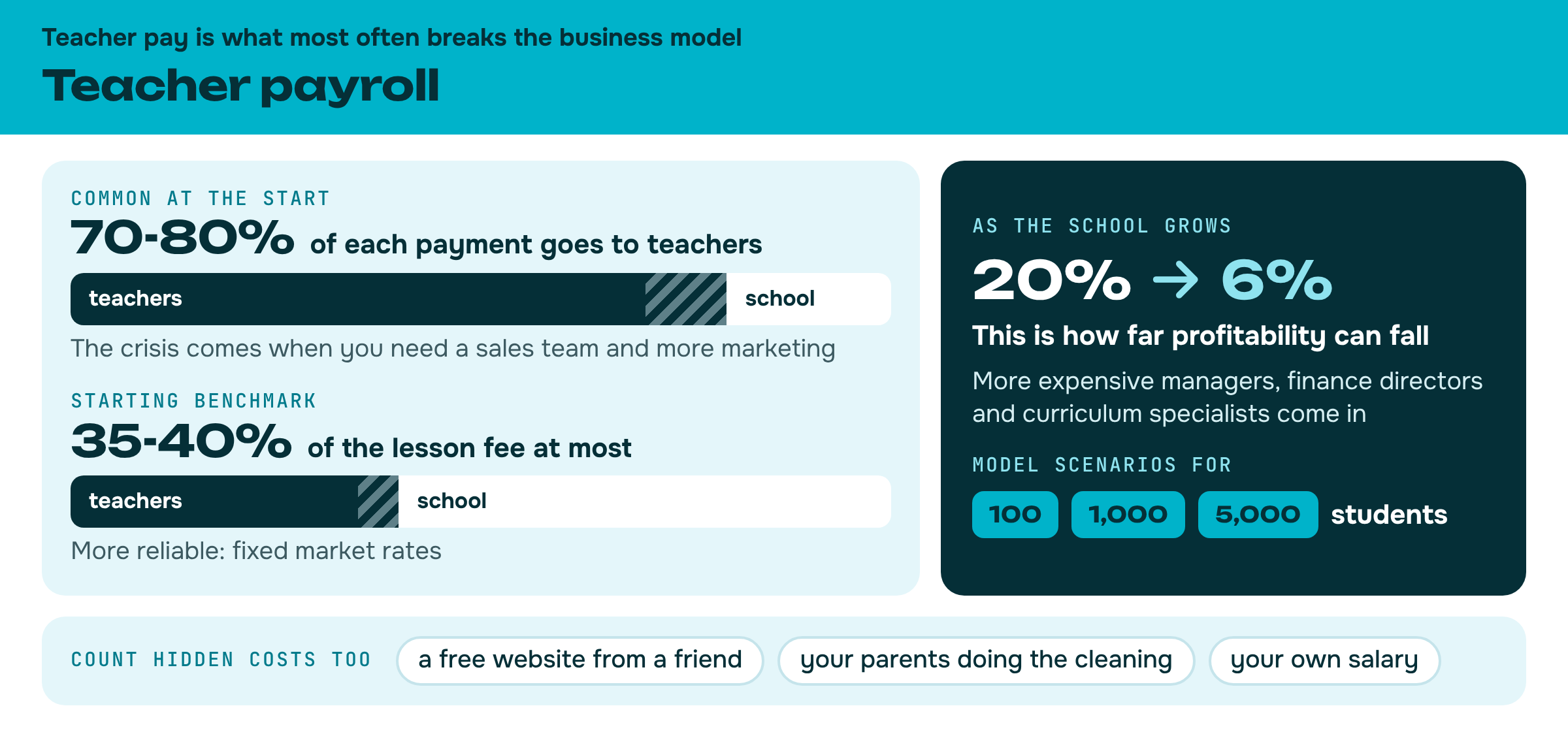
Count the hidden costs too: a free website from a friend, your parents doing the cleaning, and your own salary, even if you are not taking it out of the business yet. While these lines stay empty, the profit on paper is bigger than in real life.
And remember: scaling is not a mandatory path; a boutique school is a conscious choice too. A small team, a higher price and an owner who knows every student by name is also a working model. It is only bad when it happened by accident rather than because you decided so.
3. Niche, investment and format
Three questions worth answering before you put money into growth.
- Niche. You can do your job perfectly, but if there are no clients in the niche, there will be nowhere to grow. You can test it through search queries in Google Analytics, demographics and surveys of potential clients. Don’t ask “would you buy it?”; ask “how much are you willing to pay for it?”. People answer “yes” to the first question out of politeness; to the second they name a figure you can actually work with.
- Investment. You can buy a car and have no money for fuel: know in advance whether you have enough funds. The market benchmark for payback in education projects is 12-24 months, so you need a reserve not for the first month of advertising but for at least a year.
- Online or offline. Green Country is roughly 20% offline and 80% online, and the growth comes from online: offline is expensive because of rent, generators and bomb shelters. The market is moving the same way: on BUKI only 17.7% of requests insist on offline.
There is one more reason to look toward online: geography. In Kyiv there is already so much supply that prices for English lessons are falling, while in Dnipro and Zaporizhzhia they rose by more than 40% in a year. An online school doesn’t care which city a student lives in, and that is worth using.
4. Channels and funnels
There are performance channels (paid advertising) and brand channels (reach). The first bring leads today; the second make sure that tomorrow those leads come to you more easily. A client now needs a few dozen touchpoints before deciding: a person sees an ad, reads reviews, scrolls through Instagram, asks friends, and only then submits a request.
Which channels work
Here is what Green Country uses.
- Google Ads. The highest conversion, because clients are deliberately searching for the service.
- Meta. The most expensive, but without it the flow from Google drops too.
- Influencers. The next step after Meta for schools that are just starting to grow.
- TikTok. It doesn’t sell, but it lowers a teenager’s resistance: if the child has already seen the school in their feed, it takes less persuading.
- Ambassadors. Real students, cheap and honest.
Small schools are better off starting with Meta, then adding influencers and Google. Budget 10-15% of revenue for marketing.
How much should a lead cost? The market benchmark for online education is UAH 250-600. If yours costs twice as much, look for the problem in the ads or on the page the ads lead to. If it costs half as much, don’t celebrate too soon: first check whether these people make it to payment.
Factor in the season too. According to BUKI, there are almost twice as many new requests in September as in December or May, and a second, weaker peak comes in January. Plan your ad budget and group launches around these waves instead of splitting them evenly across twelve months.
One well-tuned funnel beats five half-built ones
For a school with 50-200 students, one or two funnels are enough: find one that brings leads consistently and scale it. The temptation to launch everything at once is strong, but five half-finished funnels deliver less than one that is properly tuned.
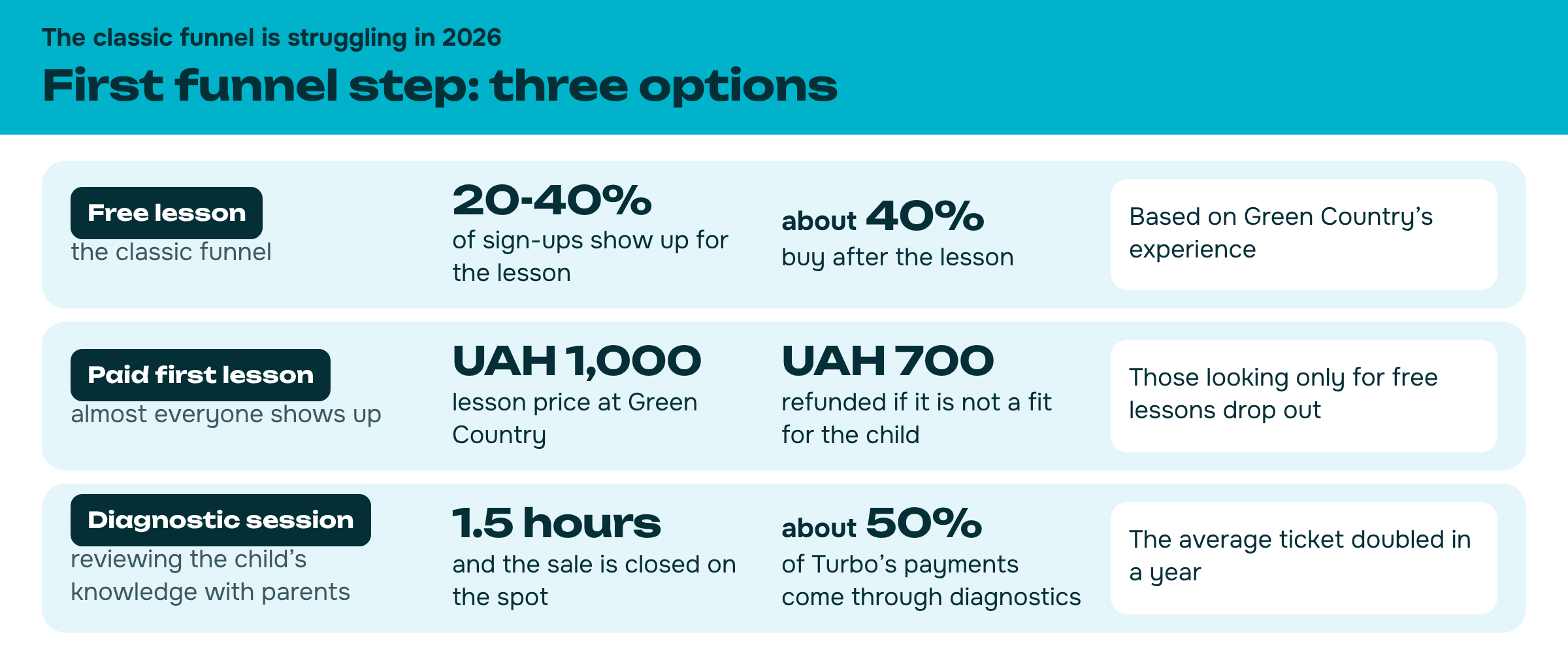
The classic funnel (targeted ads, free lesson, sale) is struggling in 2026: in Green Country’s experience, only 20-40% of those who sign up show up, and about 40% buy after the lesson.
Let’s work out what that means in money. Out of 100 leads, 20-40 people come to the lesson and about 40% of them buy, that is 8-16. If a lead costs UAH 250-600, one new client costs roughly UAH 1,600-7,500. And that is before the manager’s salary and the teacher’s hours spent on those who never bought anything.
What to replace the free lesson with
There are two alternatives, and both filter out casual visitors before the lesson.
- A paid first lesson. At Green Country it costs UAH 1,000, and if it is not a fit for the child, UAH 700 is refunded. Almost everyone shows up, and those looking only for something free drop out.
- A diagnostic session. For an hour and a half, the child’s knowledge is reviewed together with the parents, and the sale is closed on the spot. About 50% of Turbo’s payments come through diagnostic sessions, and the average ticket doubled in a year.
Turbo also invests in content marketing, Telegram channels and promoters in schools. In the funnel, track the cost per lead, conversion at each stage, channel ROI and LTV. Without these four numbers you don’t know which channel feeds the school and which one just eats the budget.
5. LTV
In 2026, the focus should be not on acquisition but on long-term relationships with clients.
Bringing in a client keeps getting more expensive. So the winner is not the one who acquired more new clients, but the one whose existing clients stay longer.
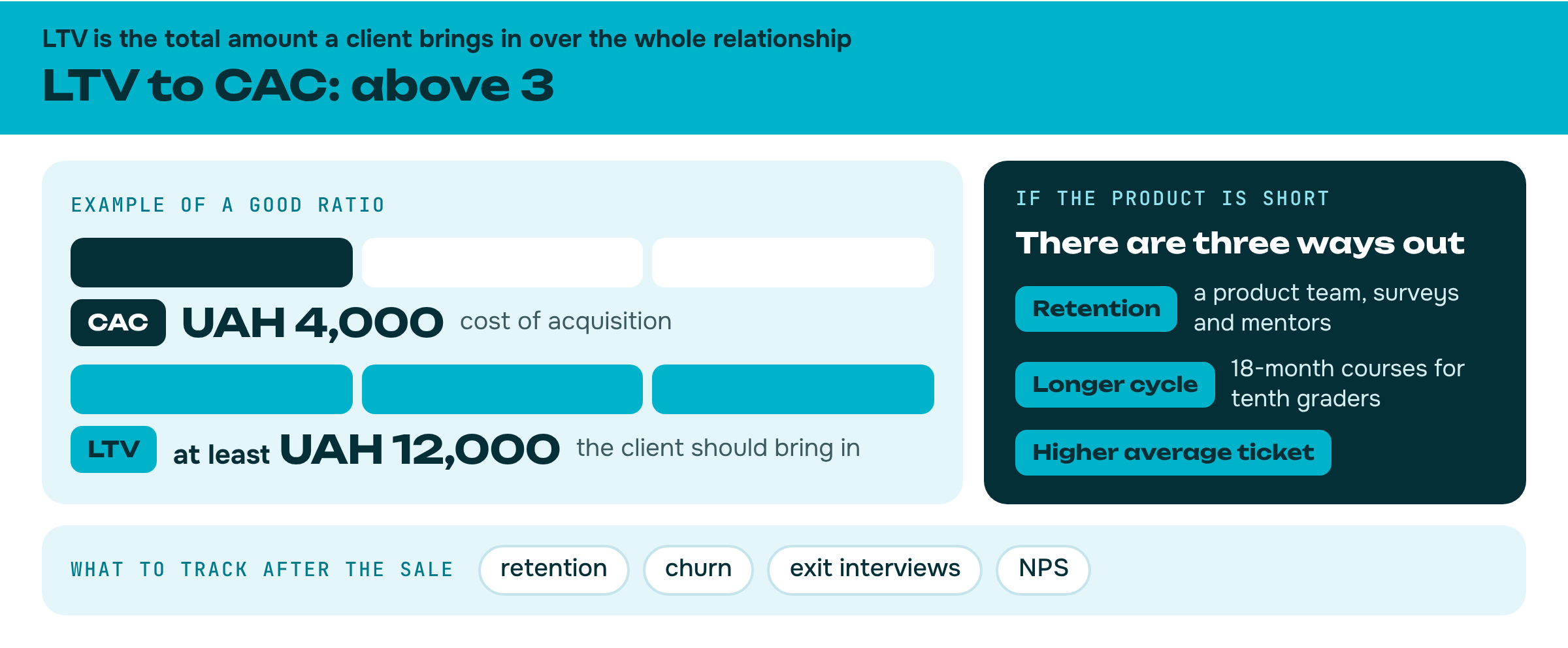
LTV (lifetime value) is the total amount a client brings in over the whole relationship. Most schools count the cost of acquisition but hardly count how many clients have left. The result is a leaky bucket: you pour in from the top with advertising, it leaks out at the bottom, and somehow the level doesn’t rise.
Track retention and churn, run exit interviews, measure NPS. An exit interview is a simple conversation with a client who is leaving: why, what didn’t work for them, what could have kept them. Ten such conversations will tell you more about your product than a hundred glowing reviews.
How much a client should bring in
A good LTV to CAC ratio is above 3: if acquisition costs UAH 4,000, the client should bring in at least UAH 12,000.
Is that a lot or a little? Let’s estimate at the market price. An hour of English with a tutor costs UAH 356 on average, so at two lessons a week a student pays about UAH 2,850 a month. That makes UAH 12,000 a little more than four months of study. If your students leave earlier on average, the model doesn’t add up, even when leads are cheap.
If the product is short
Exam preparation or an intensive course ends quickly, and the client leaves not because they didn’t like it. There are three ways out.
- Retention. Turbo has a dedicated product team, surveys and mentors for this.
- A longer cycle. For example, 18-month courses for tenth graders: the student comes not a few months before the exam but much earlier.
- A higher average ticket. Those same diagnostic sessions at Turbo worked exactly this way: the ticket doubled in a year.
6. Automation and team
Count not only money but also the owner’s time. If you spend every evening reconciling payments in a spreadsheet and writing reminders to parents, you are the most expensive administrator in your own school.
As the school grows, move from spreadsheets to a CRM and an ERP that remind about payments, deduct lessons and calculate salaries: for the system, 100 students or 1,000 is the same operation. For a person, it is the difference between an hour and a whole working day. How CRM, ERP and LMS differ and how to choose a system for your tasks is covered in our article on 51 services for automating an education business.
And to avoid spending weeks comparing websites and pricing plans, take a look at the catalog “51 services for automating education businesses”. It brings together the CRM, ERP, LMS and online platforms of the Ukrainian market on one interactive page: a matrix of 20 features, pricing for five scenarios from 10 to 800 students, and 61 ready-made recommendations for different types of education business. Access costs UAH 399, a one-time payment for 6 months. The catalog itself is in Ukrainian.

Who to start the team with
Start the marketing department with one jack-of-all-trades (for example, a paid ads specialist), then add a designer and a video maker. It isn’t worth hiring three narrow specialists at once: while the volume is small, they simply won’t have enough to do.
Standards instead of heroics
And standardize everything: whatever isn’t standardized doesn’t scale. At Green Country, since 2018, the 15th minute of the 17th lesson at level A2 has been the same in every group, so a student feels no difference when the teacher changes.
It sounds strict, but this is exactly what gives freedom. A teacher can get sick or go on vacation, a colleague picks up the group, and the student gets the same lesson. The school stops depending on a few irreplaceable people, and on you too.
7. Groups and launch
Groups have a higher margin than one-on-one lessons, but they are also where most schools stumble. Groups are hard to put together and to keep: one student has training on Tuesday, another has swimming on Thursday, a third can only do weekends.
Fill groups through fixed start dates and a clear schedule: at Green Country, with 600 groups and 5,000 students, there are only three combinations of days. Not “when is convenient for you?” but “here are three options, choose yours”. The fewer the options, the faster each group fills. And it is convenient to tie start dates to the season: September and January, when new requests are at their highest.
Retain through payment by semester: a person pays for several months, and the school guarantees that the group will finish the course on the same terms. It is a fair exchange: the client gets stability, the school gets predictable income.
Before launching a school: calculate the costs, choose a niche and test it with a survey, and launch an MVP. This is the simplest version of the product that you can sell right now: one group, one level, one teacher. It will show whether people are willing to pay before you invest in a website and a brand.
Before you scale, check
- Investment: whether you have enough funds to reach profitability. A reminder of the market benchmark: 12-24 months.
- Format and teachers: the teaching model, payroll, arrangements with the team.
- Niche and channels: whether there are enough clients and whether you know how well your channels perform. How much does a lead cost, and how much does a client?
- After the sale: retention, LTV, NPS. Does a client bring in three times more than it cost to acquire them?
- Infrastructure: a CRM and an ERP, so you can grow without growing headcount in proportion.
You are already on the right track
It is a lot of information, and it can feel heavy. That is normal: scaling really does consist of many decisions, and none of them is made in one evening. But you have already done the main thing: you looked at your school through the eyes of an owner, not just a teacher.
Don’t try to implement everything at once. Choose one step, the one that hurts most for you, and start with it this week. Not everyone needs to scale, but if you choose this path, start with the numbers. Step by step, from chaos to stable profit.