
Speaking Your Mind: New Public Speaking Lessons in English on TalkEn.Cloud
Imagine an English lesson where a student does not retell a text from the textbook or answer yet another question from the teacher. They stand in front of the group and talk about something that truly matters to them. In their own words, out loud, with confidence.
We wanted this kind of lesson to become a regular part of the course. That is why the TalkEn.Cloud library of interactive textbooks now has something new: speaking lessons with elements of public speaking. They combine work with authentic video, speaking practice and a real talk in front of an audience.
How does the course help students stop fearing small talk, conversations with strangers and public speaking?
Most English teachers know this situation. Students know the grammar and do the exercises without mistakes, but as soon as you ask them to talk about something on their own, the classroom goes silent. Someone looks away, someone answers in one sentence, someone asks whether they can say it in Ukrainian.
The reason is usually not their language level. The student lacks experience of speaking at length, in front of other people, without a ready-made prompt. Pair dialogues and answering questions are useful, but they do not teach the main thing: how to gather your thoughts, build a statement and get it across to listeners.
Public speaking is a skill that is almost absent from the school curriculum. Yet everyone needs it in life: when defending a project, at a job interview, during a presentation at university, in a conversation with a stranger. The new lessons close this gap:
- they remove the fear of speaking in front of an audience in a safe environment;
- they show that confidence is not an innate talent but a set of specific techniques;
- they give students the experience of “I went out, I spoke, and it worked”.
This experience works far beyond the English lesson. A student who has once spoken in front of the group in a foreign language feels much calmer both at a school event and at their first job interview.
An English lesson is ideal for this kind of practice. Here students are used to making mistakes: a mistake is a normal part of learning, not a reason for shame, so stepping out in front of the group is psychologically easier. A limited vocabulary makes them speak more simply and clearly, and this skill later comes in handy in their native language too. And new words and grammar stop being abstract rules: students use them right away to tell their own story.
What these lessons are and who they are for
The lessons are built around an authentic video: a talk by a real speaker. Often it is a talk by a teenager, a peer of our students, who went on stage and shared their idea with the world. Students watch the video not just as listening material. They analyze it as a model: how the speaker holds attention, builds an argument, uses their voice and deals with mistakes.
And then they do the same.
The video here is not background or a break between exercises, but a model that students follow. They see that you can give a talk at 13 or 16, that speakers get nervous too, pause and sometimes stumble. And that this does not stop them from being convincing.
The lessons are divided into three age groups: primary school (grades 1–4), middle school (grades 5–7) and high school (grades 8–11). They cover all levels from pre-A1 to C1+, including the 24 Easy Steps courses for young learners. For the youngest, a simple educational video or cartoon can replace a speaker’s talk, and the “talk” becomes a rhyme, a tongue twister or show-and-tell.
The format suits group classes in language schools, clubs and tutors who work with mini-groups. It works best where there are at least a few listeners.
How these lessons differ from regular ones
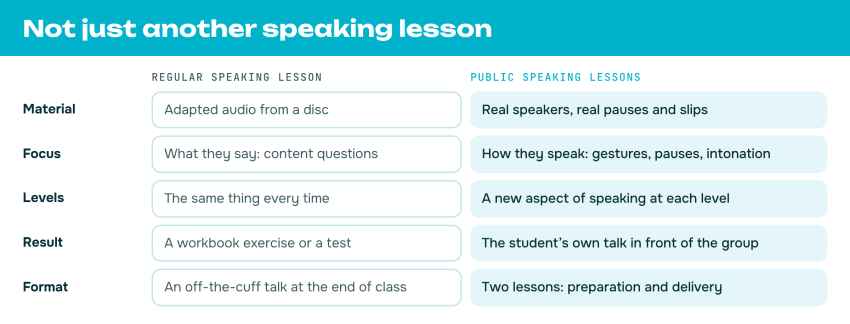
- Authentic material instead of a textbook. Real speakers, real language, real pauses and slips of the tongue, not adapted audio from a disc.
- A focus on how people speak, not only on what they say. Students learn to notice gestures, pauses, intonation and rhetorical questions, and to understand which techniques make a speech convincing.
- Each level has its own aspect of public speaking. One level works on clear pronunciation, another on body language, another on the structure of an argument. The aspects do not repeat; they build up from level to level.
- The result is the student’s own talk. The student creates their own product and presents it to the group.
- Two lessons, one story. The first lesson is preparation, the second is delivery. They do not work separately.
How skills build up from level to level
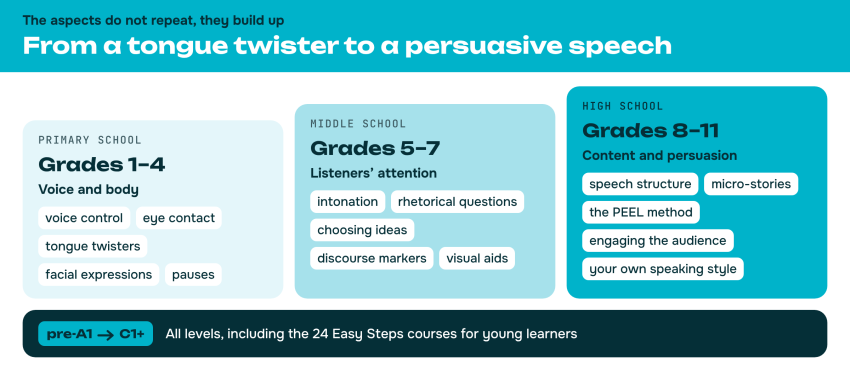
In primary school, students work mainly with their voice and body: they learn to control their voice and emotions, make eye contact, improve their diction with tongue twisters, and use facial expressions and pauses to emphasize meaning.
In middle school, the focus shifts to the listeners’ attention. Students master intonation and the melody of speech, turn statements into rhetorical questions, select ideas for a talk and use discourse markers. A separate aspect is devoted to using visual aids.
In high school, students move on to content and persuasion. They master the classic structure of a speech, learn to justify their own position, tell micro-stories and engage the audience. At higher levels they work with the PEEL method (Point, Example, Explain, Link), critical analysis of information, handling communication crises during a talk and developing their own speaking style.
Each level adds a new building block, and over several years a student goes from a tongue twister to a persuasive speech.
How the classes work
Each cycle consists of two lessons.
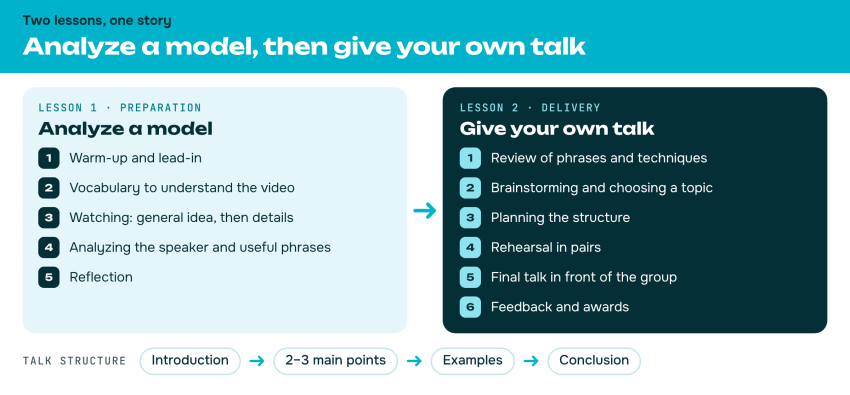
Lesson 1. Analyze a model
Warm-up and lead-in → vocabulary needed to understand the video → watching the talk with tasks (first for general understanding, then for details) → analysis of how the speaker presents and learning useful phrases students will use themselves → reflection.
The most interesting stage is the analysis. Usually, after watching a video, students answer questions about its content. Here they also look at the talk through the speaker’s eyes: where they paused, how they began, what convinced the audience. Watching in two stages helps even lower-level students not to get lost in live speech.
After the first lesson, a student has not only new words but also a clear idea of what a good talk looks like and which techniques it is made of.
Lesson 2. Give your own talk
Review of phrases and techniques → brainstorming and choosing a topic → planning the structure of the talk (introduction, 2–3 main points, examples, conclusion) → rehearsal in pairs → final talk in front of the group → feedback and awards.
The rehearsal in pairs is not a formality: this is where students get through the first wave of nerves and get their first reaction, so they face the group with more confidence.
The topic of the talk is always the student’s choice. This determines how sincere and lively the talk will be. To get started, you can suggest a few ideas:
- primary school: my favorite toy, my best day, an animal I would like to be;
- middle school: a hobby everyone should try, whether students need homework, how to make our school better;
- high school: whether screen time should be limited, a profession of the future, a skill that school does not teach but should.
The best talks usually come when a student brings something of their own: a story from their life, an unusual hobby or a question that genuinely concerns them.
Everyone gets recognition
At the end of the second lesson the group votes, and each participant gets their own award. “The brightest voice”. “The bravest speaker”. “The best team”. “The most convincing argument”, and so on.
This is our principled position: there is no single winner and a crowd of other participants. Everyone leaves with concrete confirmation of their strength, and with the desire to speak in public again.
If after a talk a student hears only a list of mistakes, next time they will try to avoid the stage. If they get recognition for what went well, they remember the experience as a success. And the group learns to notice others’ strengths and to assess talks by specific criteria.
What students get
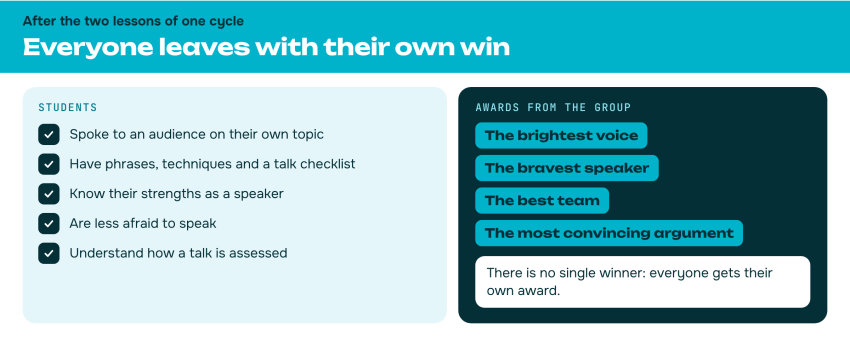
With each new cycle, these results add up. A student who takes the course over a year speaks in front of the group many times, and each talk adds a new skill. By the end of the school year, they already know how to open a speech, how to hold attention and how to end a talk so that it is remembered.
What the school and the teacher get
- Ready-made lessons without hours of preparation. Videos, tasks, vocabulary and assessment criteria are already selected: the teacher opens the interactive textbook and works with a ready structure.
- Visible results for parents. A talk in front of the group is the clearest proof that a child really speaks English. If you plan to film the talks and publish them, get written consent from parents in advance.
- A difference from competitors. A course where students systematically learn public speaking is easy to understand for parents looking for a skill for their child’s future.
- Flexibility. The lessons can be added to existing courses as a regular module, run as an intensive or offered as a separate speaking course.
Tips for the teacher before the first talk
- Start with yourself. Show students a short talk of your own using the same structure.
- Do not correct mistakes during the talk. Note them down and come back to them in the general feedback.
- Praise specifically. Instead of “well done”, say: “You made a great pause before your main point”.
- Take care of the atmosphere. We listen carefully, do not interrupt and support with applause. A safe environment matters more than perfect pronunciation.
- Trust the awards. Even the quietest student should get their recognition. Sometimes “The bravest speaker” is exactly the one for whom it was hardest to step out.
How to get started
The public speaking lessons are available in the TalkEn.Cloud library of interactive textbooks. Log in to the platform, find the lessons for the right age group and level, assign them to a group and run the first cycle of two lessons.
Public speaking is not an innate talent but a skill that can be learned. Give your students a stage, and they will surprise you with what they have to say.
Speaking your mind, out loud and with confidence, can be learned. Start with two lessons.