
Business Analysis: A Step-by-Step Guide to Growth
In short: Business analysis starts with the business model (what you sell, to whom, how and for how much), then covers the client, niche, product, learning materials, data, marketing, the sales department and the team. Regularly check profit, the break-even point and payback on investment.
Hello!
Do you dream of understanding better how your business works and how to take it to the next level? This guide is for you.
It will help you see your strengths and weaknesses, structure your business model, optimize processes and make your business more profitable and resilient. Whatever stage you are at now, starting out or scaling up, you will find practical answers here.

Business is about efficiency, not just inspiration
You may really love what you do. But a business is not a hobby. It has to make a profit. Not out of greed, but in order to survive, grow and develop the team.
Regularly analyze:
- whether the business makes a profit;
- if not, why exactly (reinvestment, seasonality, a change of strategy);
- what your break-even point is;
- when your investment will pay off.
Business model: where it all begins
The heart of your business is the business model. It answers the questions: what you sell, to whom, how exactly, for how much and at what cost.
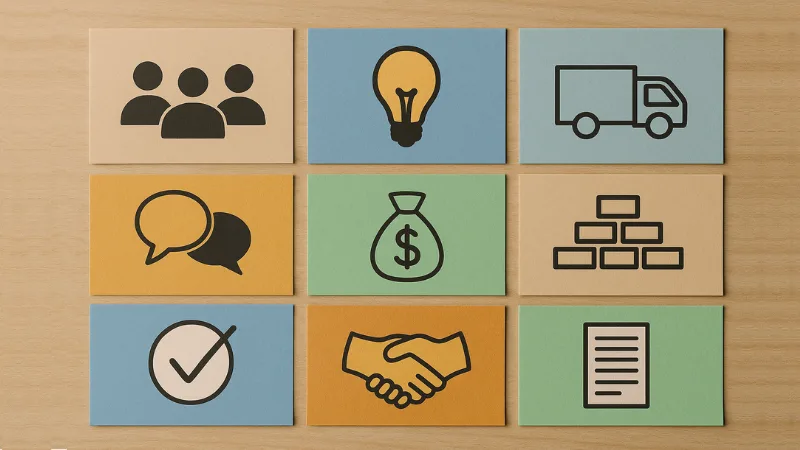
To visualize all this, use the Business Model Canvas. It is a simple, clear framework that helps you break your idea down into 9 key blocks. With it, it is easy to see where the weak spots are and where there is potential for growth. Learn more about useful tools in this video (in Ukrainian).
The client is the main character
Your business exists only because a client is willing to pay for your product. So:
- describe your target audience clearly;
- find out what matters to them;
- formulate an attractive value proposition;
- choose effective communication channels;
- work toward long-term cooperation.
The better you know your client, the more steadily your income grows. On this topic, you may find this video (in Ukrainian) useful: it covers how to work effectively with clients and organize learning to grow an online school.
Niche: look for your point of differentiation
Even if the market is already saturated, there is always room. An example: an exam preparation school that works in the evenings. It takes into account students’ rhythm and teachers’ schedules. A simple solution that created value. The moral: you do not always need to create something radically new. You need to create something convenient and needed.
You can learn about other ways to stand out from competitors in this video (in Ukrainian).

Product: clear, understandable and logically structured
Your product should have clear packaging:
- a name;
- a program;
- a duration;
- a price;
- a format (course, membership, intensive and so on).
Do not create too many options: it only confuses the client. Important: each offer should have its own purpose and not compete with others within your own business. It is also very important to remember standards and rules in how a language school works: how to organize lessons, form groups and set payment terms. We talk about this in this video (in Ukrainian).
Learning materials are the foundation of an educational product
Quality of the program = quality of the result. Use either proven ready-made materials or create your own: systematic, logical and easy for a new teacher to adapt to. This ensures:
- consistency;
- client trust;
- ease of scaling.
And do not forget about an LMS: it saves time and improves the quality of service. You can learn more about one of them in the video below (in Ukrainian).

Data: everything is measured
Track:
- where clients come from;
- how much it costs to acquire one client (CAC);
- how much a client brings on average (LTV);
- how often they come back;
- which sales channel is the most effective.
And most importantly, ask for feedback regularly. It is the clients who will tell you what to improve. In this field it is important to keep your finger on the pulse and follow current trends in educational technology. Watch the video (in Ukrainian) about it.
Marketing: it doesn’t have to be expensive, it has to be smart
Marketing is not about big budgets. It is about efficiency.
Affordable options include:
- YouTube or TikTok videos;
- partnerships;
- word of mouth;
- micro-influencers;
- a personal blog. You can learn more about how to run and grow a personal blog in the video below (in Ukrainian).
At the start, it is important not to “burn” money on ads, but to test, measure and adjust.

A sales department, even if you are the only manager
Even a small school needs a system:
- who answers requests;
- how a client is handled;
- which CRM is used;
- how payments are recorded;
- who collects reviews.
Order → calm → growth.
Building and keeping a team
Automate onboarding and training for new employees. Create process templates, training materials and instructions to avoid duplicated effort and speed up the adaptation of newcomers.
Document key knowledge and processes. Do not rely only on employees as carriers of knowledge. Build an internal knowledge base that stays available regardless of staff changes.
Plan the team structure in stages. Develop a growth model (Team 1.0, 2.0 and so on) that lets you scale gradually, in line with the size of the business.
Optimize the team regularly. Analyze each employee’s workload and efficiency, and add new roles only when it makes economic sense.
You can learn about every aspect of building a language school, from positioning to building a team, in this video.

Types of teams in an education business
The core of an education business usually consists of:
- a team of teachers and methodologists;
- a sales and customer service department;
- a marketing team.
Bring in external specialists when needed. For tasks that do not require a permanent presence (design, website development, technical support), it makes sense to work with freelancers or agencies.
Define clear functions for each department. This ensures that responsibility is shared, work is transparent and tasks are not duplicated.
Finance: accounting and analytics
Introduce daily tracking of income and expenses. Keep a simple spreadsheet or use specialized services to control cash flow.
Analyze cash flow and P&L every month. Cash flow lets you track the real movement of money, while the P&L shows how much the business earns after covering costs.
Separate personal and business finances. Use separate accounts and cards to avoid mixing expenses and to have an objective picture.
Create and regularly update a “plan vs. actual” document. Record planned expenses, compare them with actual ones and identify deviations for further analysis.
You can learn more about how to manage finances effectively without unnecessary chaos at our webinar.

Financial metrics: analyzing efficiency
Track the key metrics: CAC, LTV, ROMI. CAC (customer acquisition cost), LTV (customer lifetime value) and ROMI (return on marketing investment) are the basis for financial decisions.
Keep the LTV to CAC ratio at 3:1 or higher. This shows that your business model is profitable and viable.
Analyze the average order value. Its growth can signal successful changes in pricing or product updates.
Regularly assess CRR (customer retention rate). A high retention rate means that clients are satisfied and stay with you for a long time, which is more profitable than constantly attracting new ones.
And finally, analyze regularly.
A business is like a plant: it needs constant care to grow. By coming back to analysis every month or every quarter, you will be able to spot weak points in time and find new points of growth.
Save this guide. Come back to it when you feel that something “isn’t working” or you need a push for a new stage. Your business is a living organism. Take care of it with wisdom and love.
FAQ
Where do I start analyzing an education business?
With the business model. The Business Model Canvas helps visualize it: 9 key blocks that show weak spots and growth potential.
Which metrics should I track?
Where clients come from, how much it costs to acquire one client (CAC), how much a client brings on average (LTV), how often they come back and which sales channel is most effective.
Does a small school need a sales department?
Yes, even if you are the only manager: you need a system for who answers requests, how a client is handled, which CRM is used, how payments are recorded and who collects reviews.